
All Categories
Get upto 25% OFF on All Order - SHOP NOW
Availability: Low stock: 1 left
Couldn't load pickup availability
Free shipping and returns available on all orders!
We ship all US domestic orders within 5-10 business days

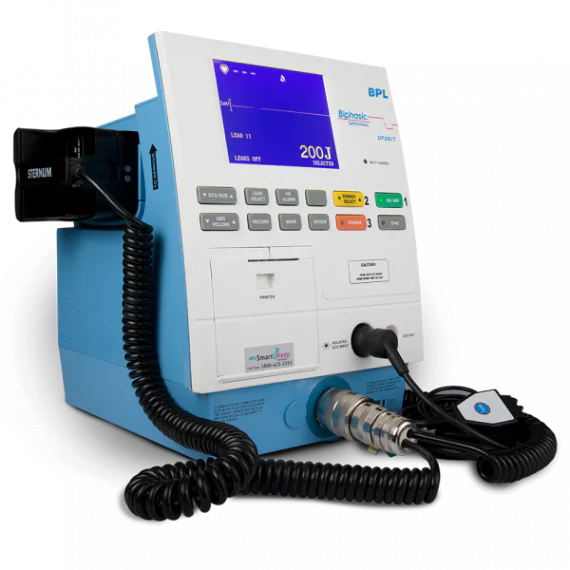
The BPL DF2617R Biphasic Defibrillator with Recorder is an advanced cardiac emergency response device designed for rapid and effective treatment of sudden cardiac arrest (SCA) and life-threatening arrhythmias. It utilizes current-controlled biphasic waveform technology to deliver efficient shocks while minimizing myocardial damage. The device supports both Manual and AED operation modes, making it suitable for trained healthcare professionals as well as guided emergency use.
Its integrated thermal recorder enables ECG and event documentation, while the 5.7-inch LCD display provides clear monitoring and operational guidance. The system also includes synchronized cardioversion, remote paddle charging, and event recording capabilities for enhanced emergency care.
| Specification | Details |
|---|---|
| Brand | BPL Medical |
| Model | DF2617R |
| Type | Biphasic Defibrillator with Recorder |
| Waveform | Current-Controlled Biphasic |
| Display | 5.7-inch LCD Screen |
| Energy Range | 2J – 300J |
| Modes | Manual Defibrillation, Optional AED Mode |
| Cardioversion | Synchronized Cardioversion |
| Event Recording | Up to 24 Events |
| Recorder | Integrated Thermal Recorder |
| Battery Performance | Up to 100 shocks at 300J on full charge |
| Charging Method | Remote Charging Through Paddles |
| ECG Monitoring | Pre- and Post-Shock ECG Recording |
| Weight | Approx. 5.66 – 6 kg |
| Paper Type | 50 mm Thermal Paper Roll |
| CPR Assistance | Voice Prompts & Metronome (AED Version) |
✔ Biphasic shock delivery for improved patient safety and effectiveness
✔ Adjustable energy settings from 2J to 300J
✔ Large 5.7-inch LCD monitoring screen
✔ Built-in thermal recorder for ECG and event documentation
✔ Stores and reviews up to 24 event records
✔ Supports synchronized cardioversion procedures
✔ Remote charging and shock delivery through paddles
✔ Up to 100 discharges at 300J on a fully charged battery
✔ Optional AED mode with CPR guidance and voice prompts
✔ Suitable for hospital, ambulance, and critical care environments

